


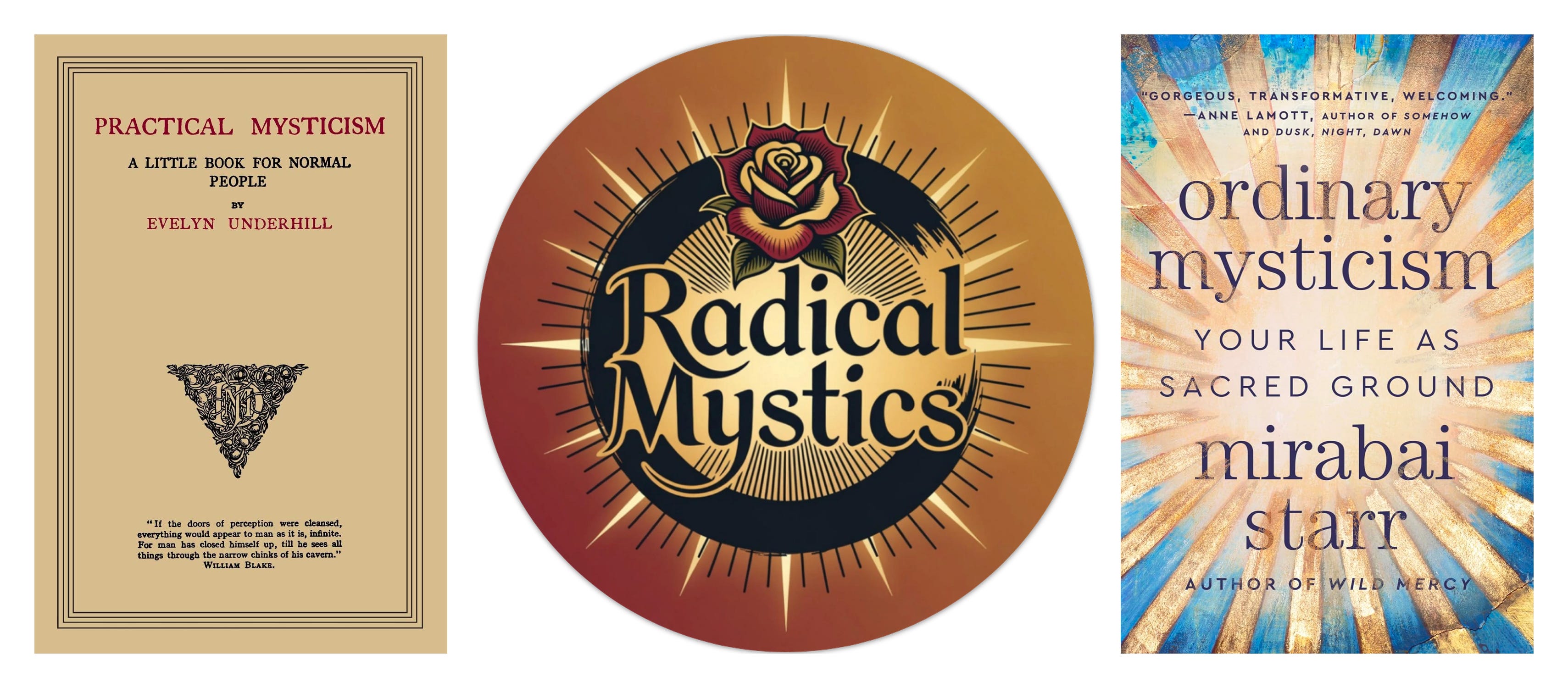
Evelyn Underhill, the renowned 20th century authority on the inner life, famously titled one of her most enduring books as Practical Mysticism: A Little Book for Normal People. Now, I do tend to stumble over the word “normal” in that title — truth be told, I am much more comfortable with thinking of myself as “weird.” But it’s helpful to remember that Underhill was not writing for artists and Bohemians. She saw doctors, lawyers, business leaders, and other mainstream folks as her audience: these are the “normal” folks whom she believed were just as called to the interior life as are the most austere saints, nuns, and monks.
A century later, another term to help us think about experiential spirituality has emerged: the concept of ordinary mysticism. Mirabai Starr, Mark Longhurst, Dennis Tamburello, and Albert Haase are some of the authors of our time whose work explores ways to understand the mystical life as ordinary. It seems that ordinary mysticism is even more down-to-earth than its practical predecessor. If a practical mystic is the kind of person whose spirituality pairs well with the most mundane qualities of modern-day life, then an ordinary mystic is anyone who intuitively recognizes that you don’t need to run off to a monastery, or engage in extreme fasting, or do any other kind of on-the-edge activities, in order to be accepted as a “true” mystic. Experiential spirituality is for everyone — and especially, it would seem, for people who are truly humble, completely down-to-earth, and at home with the most quotidian circumstances of our lives.
When Debonee Morgan and I were coming up with a theme for our program at the Wild Goose Festival’s Wisdom Camp in 2025, we could easily have opted to call our approach to mystical spirituality either “practical” or “ordinary,” following the concepts that these writers have explored in their various books. But we opted instead for the concept of radical mysticism. Let’s look at a few ideas that help us to understand what puts the “rad” into radical mysticism.
The first thing that needs to be said: I’m not sure that any of these terms are mutually exclusive. Hopefully, a practical mysticism is also an ordinary mysticism — and vice versa. And hopefully, a radical mysticism, at its best, is also thoroughly practical and ordinary. When we try to understand the distinctions between these words, we’re not trying to create any sort of firewall between them; rather, we are hoping to let these different words with their different meanings illuminate and inform each other, so that our overall sense of mystical spirituality is deepened, not fragmented, by these three different approaches.
In a nutshell, then, let’s consider what these different ways of understanding mysticism are saying to us about spirituality — in a way that sheds light on how we can go deeper.

Here’s one way to approach these three concepts:
Practical mysticism emphasizes how mystical spirituality is embedded in something we do, something we perform. It’s “practical” to engage in Centering Prayer, to pray and meditate daily, to go on retreats and work with spiritual directors. Practical mysticism is mysticism in practice.
Ordinary mysticism reminds us that mysticism is down to earth, and that ordinary people get to be mystics as much as great saints or theologians do. This is mysticism for the rest of us, mysticism that doesn’t put on airs, mysticism that finds beauty and truth and purpose in the humblest corners of everyday life.
Radical mysticism is spirituality that is deeply rooted: it gets to the bottom of things. It’s mysticism on the edge, but also mysticism at the foundation of wonder and in the center of joy. This is not extremist except maybe in the sense of extreme joy, extreme purpose, and extreme meaning. This is not mysticism that tells us what to believe: rather, it is a type of mysticism that invites us into greater wisdom and freedom which makes it possible to decide for ourselves what we hold as true, and good, and beautiful.
If a radical is someone who refuses to accept the brokenness of the status quo, then a radical mystic is someone who wants to rethink religion and spirituality from the ground up.
If a radical is someone brave enough to fight for meaningful change, to bring real solutions to real problems, then a radical mystic is someone with the courage to identify the spiritual problems that people experience, and try to find meaningful new solutions that can help us all to make the world a better place.
If a radical is someone who wants to get to the real root of a problem rather than just addressing the symptoms, then a radical mystic is someone who sees spirituality as an invitation to go truly deep in our own hearts, minds, bodies, and souls, so that we might get to the root of what can help us all to find true joy, purpose and meaning in our spiritual lives.
As I write these words, I feel that I must be clear: I’m not there yet. Maybe none of us are. But I’m willing to do the work to steer my life into this radical new direction: where spirituality matters, where change is real, and where new possibilities can revolutionize the ways we live our lives.
Now, let’s be practical and look for ways to live the promise of radical mysticism in the most ordinary ways we can!

A Reminder: Radical Mysticism is the theme of Wisdom Camp at the Wild Goose Festival!
Like last year, Debonee Morgan and I are leading a day-long workshop on Thursday, September 3 on the theme of “Radical Mysticism.” We’d love to see you there.
The Wild Goose Festival is a camping event, although hotels and AirBnB rentals can be found in the vicinity. Admission to the festival covers all programming from Thursday evening through Sunday morning; if you want to attend the Thursday “Wisdom Camp” program, there is a separate admission fee just for that event.
Visit www.wildgoosefestival.org to learn more about the Wild Goose Festival.
To purchase your tickets for both Wisdom Camp and the main festival, click on this link: www.wildgoosefestival.org/tickets/and select “Buy Tickets Now.” Remember to use the code A-CM to get $50 off of your adult regular admission. Register now, and we’ll see you then!

Really well done, Skye!! I love how you make it really clear that it’s not one thing over another. It’s one thing and another, or integrated into one another.