


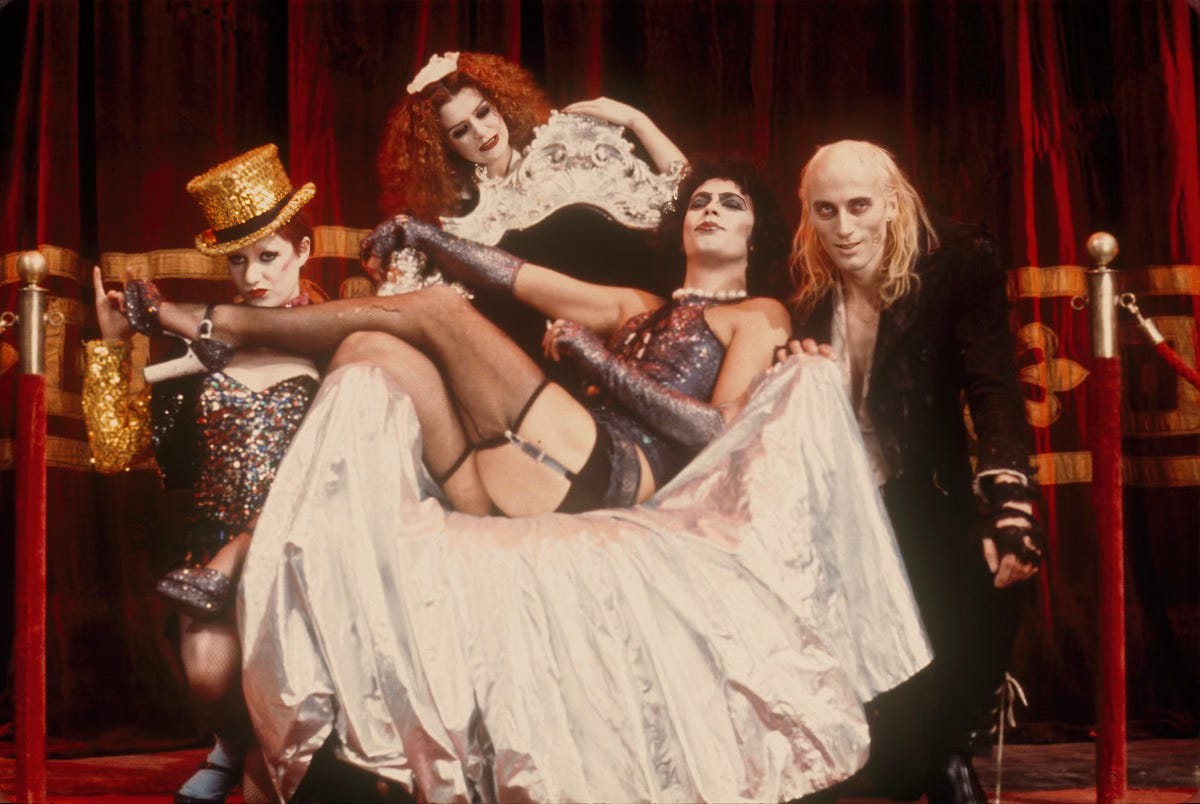
Tim Curry has died. He was eighty years old.
By all accounts, he was a quiet and humble man, polite and professional in his work as a singer and actor. A heavy smoker who suffered a debilitating stroke when he was only 66, in recent years he had been confined to a wheelchair and worked mainly as a voice actor. Now he is gone, and we are left to reflect on his legacy as a performer.
For many of us, that legacy centers on The Rocky Horror Picture Show. That makes it a troubled legacy, and I’ll get to that. But first, I’ll share my own story in relation to that film and the impact it had on me, especially as a young (and very closeted) adult.
I only saw it in the theater a couple of times, so it was not nearly as impactful in my life as it was among some of my friends — some of whom went to see it, back in the day, just about every weekend. I first heard of it when I was in high school, when the organist at my church (how deliciously ironic that is) mentioned seeing it (and loving it).1 Sometime after that, I looked at the soundtrack album when I visited the record store, but I thought it looked weird, so I didn’t buy it. Clearly, I wasn’t ready for Rocky Horror!
Then I went off to college, and briefly dated a woman who was one of those who liked to see it every weekend. But that was when she was back home in D.C.; it wasn’t playing anywhere near our rural college, so I never got to see it while we were dating. But she told me all about it.
Like me, she was a refugee from charismatic Christianity — but she was much further along in her liberation from that world, meaning she was much more, shall we say, experienced than I was. We were a bit mismatched and clearly wanted different things out of our relationship (I don’t think she would have used that word), so of course it didn’t last. But we were together long enough for her to tell me all about Rocky Horror.
I learned about what happened at the screenings (my buddy the organist talked cryptically about people throwing toast, but my not-quite-girlfriend helped me to connect the dots). She patiently explained the cosplaying culture at The Rocky Horror Picture Show. I had never heard of cosplaying of any stripe, so this was a fascinating world she was giving me a glimpse of. “I always go as Magenta,” she announced. Wanting to be included, I asked her what part I should play. She thought I was cute, so she said “You could be Rocky” — but that made other friends laugh, for they all insisted I could only be Brad.
When I finally did see the movie, about six months after breaking up with that woman, I was both amused and mortified to learn that Rocky was a physically gorgeous man who strutted around wearing nothing but a gold bikini bottom, while Brad was… well, to call him a nerd would be a bit of an insult to nerds. We’ll leave it at that.
But here’s a secret. When I saw the movie, there was only one character I wanted to be. And that, of course, was Frankie.
Over at the Frankenstein Place
Frankie is the affectionate nickname for the character Tim Curry played: Dr. Frank-N-Furter, the mad scientist who is the central figure in The Rocky Horror Picture Show. As his name suggests, he’s a spoof of Frankenstein; Rocky Horror was the “monster” he created (“come up to the lab / and see what’s on the slab”). But this is not Peter Cushing’s or even Gene Wilder’s Frankenstein. Only 28 years old at the time of filming, Curry was young, gorgeous, and completely at ease playing a “sweet transvestite from transsexual Transylvania.” Dolled up in makeup and wearing only a corset, fishnet stockings, pearls, sparkly elbow-length gloves, and tiny black undies for much of the film, he was provocatively transgressive in his appearance — let alone his actions. As the story progressed, he proceeded to seduce both Brad and Janet, the naive young fiancées who stumbled into his mansion one dark and stormy night.
When I was a freshman in college, Frankie was basically an embodiment of my shadow, in the Jungian sense. Swaggeringly confident, aggressively bisexual, joyfully genderqueer (before that word even existed), he was basically everything I secretly, secretly wanted to be, but could not bear to admit — not even to myself.
The spiritual heart of The Rocky Horror Picture Show consisted of a lovely ballad called “Don’t Dream It, Be It”2 — where Frankie shares his hedonistic philosophy with Brad, Janet, Rocky and his servant Columbia. The scene, which culminates with the characters swimming (and caressing) in a pool, is as dreamy as the song. Its message — that it’s possible to live your authentic self, and not just spend your days fantasizing about what might be — is, frankly, something I am still learning to manifest in my own life.
Spoiler alert: The story actually goes south pretty dramatically after that idyllic moment. It is revealed that Frankie is actually an alien from another planet; his henchman Riff Raff (played by Rocky Horror creator Richard O’Brien), also an alien, has been tasked with taking over their “mission” and in the process kills Frankie, Rocky and Columbia. The aliens depart, taking the mansion (actually a disguised spaceship), and leaving the surviving earthlings behind to ponder the insignificance of human life.
It’s a bleak and rather existentialist end to a colorful and transgressive film, and frankly I consider it to be one of the most unsatisfactory movie denouements of all time. But that’s not the only problem with The Rocky Horror Picture Show. While it is a campy and goofy sendup of B-movie horror flicks, its treatment of sexual hedonism and gender diversity has not aged well at all. Today, it is easy to see the movie as relying far too heavily on stereotypes that are simply harmful. Frankie, as a character, is violent and predatory, his behavior clearly manipulative, especially with Brad and Janet, meaning that the film seems to suggest that there is something, well, unsavory and disturbing about genderqueerness.
It’s not surprising that it is not at all universally loved by queer people today, especially those who were not yet born when it was first released.
Back to Tim Curry. In recent years, he was well aware of how complicated Rocky Horror’s legacy turned out to be. Here’s a screenshot from a social media post of his from a couple of years back.
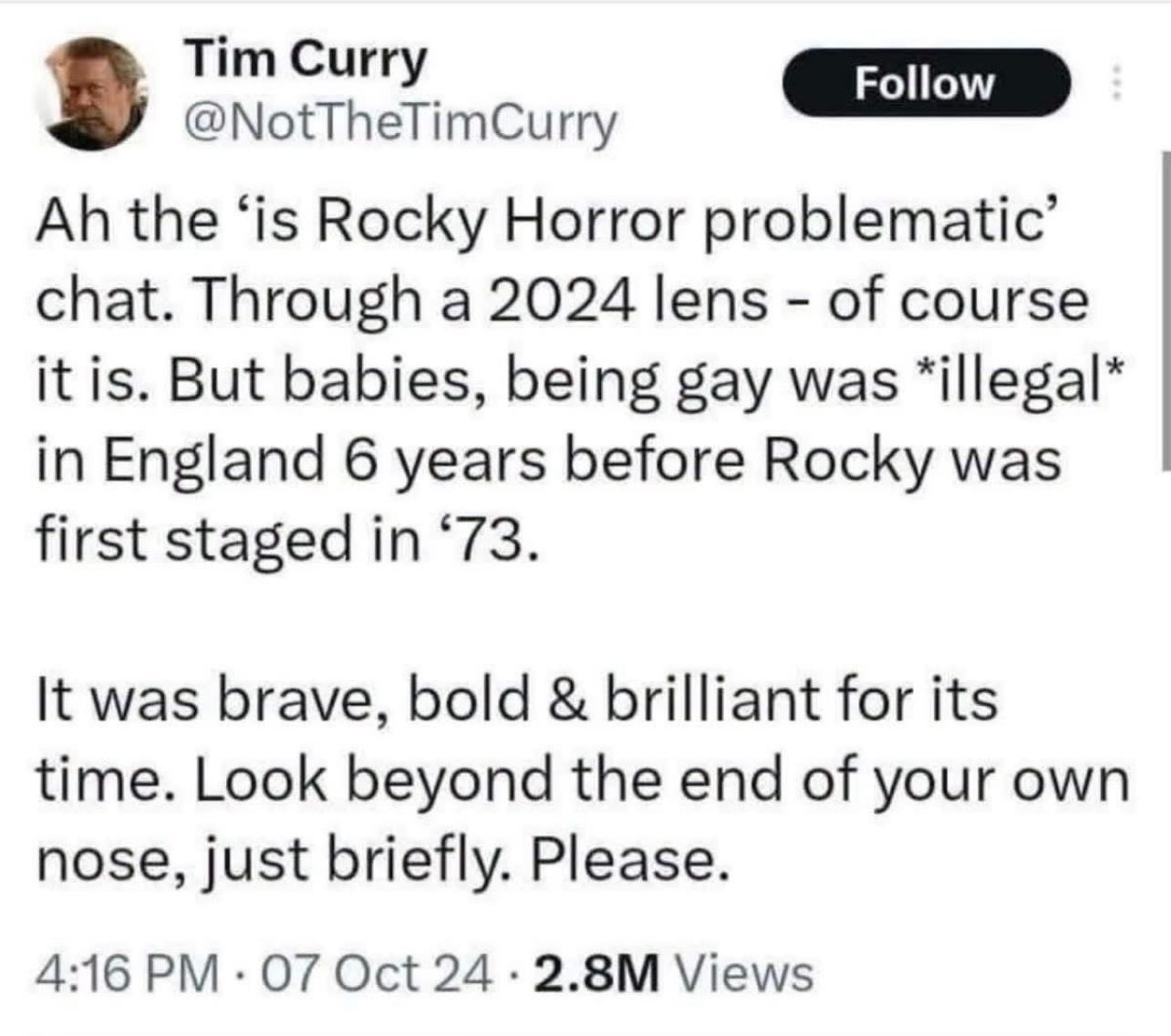
His cheek notwithstanding, I completely agree with his sense of history and context. In its day, The Rocky Horror Picture Show was a triumph for queer visibility and for just plainly celebrating both bisexuality and gender beyond the binary. And it was far, far too enmeshed in the prejudices of its time, and therefore it has aged very poorly. Both of these things can be true, simultaneously.
The first time I saw the movie was in 1980, and it was fun and playful and felt liberating. It would be almost a decade before I saw it again, not because I was avoiding it — but simply because I never felt the need or found the opportunity to go back. I finally did see it again in the theater after I moved to Atlanta. It was 1988 and I had a steady girlfriend, so we thought it would be a fun date. I was bitterly disappointed. The crowd seemed loud, aggressive rather than transgressive, and the sense of fun was simply not there. More shouting, less flirting. I don’t know if white middle class America had changed a lot in those eight years (the years of the Reagan administration, interestingly), or if it was just that I had changed. Either way, whatever magic I found in Rocky Horror as an undergraduate seemed to have disappeared. One cannot step in the same river twice.
Let’s Do the Time Warp… Again
I never truly came to grips with my own genderqueerness until I was well into my midlife years. But when I think back on how Frankie made me feel, I can see so clearly now that it was in me, just waiting to break through my anxiety and my inhibition so I could do more than just “dream it” — I really could “be it.” But at the time, the closet was just too tightly locked.
And now Tim Curry is gone. As I have read various encomia for him in the days since his passing, I have come to realize that for many people in the LGBTQ+ community, his portrayal of Dr. Frank-N-Furter was truly iconic: a watershed representation of authenticity, of freedom, of the promise of living one’s true self.
And it’s that concept — of the true self — that makes it appropriate for me to write my own appreciation of Curry on this particular Substack. For what is “Radical Mysticism” if it isn’t an invitation to be one’s radically true self?
I know that when I think about mysticism, even now, I am much more likely to think about Julian of Norwich or Howard Thurman than about Dr. Frank-N-Furter. But maybe as we mourn Tim Curry, it would be worth taking a moment to rethink that a little.
The character of Frankie is deeply flawed and highly problematic, and arguably may have done as much stereotypical harm as liberating good. But mysticism always acknowledges that we human beings are a broken, messy lot. Why should Frankie be any different?
For me, he will always represent the promise of my own erotic and nonbinary authenticity, just as Evelyn Underhill or Ram Dass represent the promise of my spiritual, contemplative authenticity. I’m still trying to live into the fullness of both of those authenticities — which means, I owe just as much of a debt of gratitude to Tim Curry as I do to all the contemplative authors I love.
Dear ones, whether you are being called into the deep authenticity of the mystical life, or of political activism, or simply of being your most fabulously queer (or straight, or cisgender) self: don’t dream it, be it. As they say: be yourself, everyone else is taken.
And as for Tim Curry: may he rest in peace.
The last time I saw this particular friend, about a decade ago, he couldn’t stop talking about Kinky Boots. Some things never change.
The middle section of “Rose Tint My World.”